In my first video, I told a story I’d heard many times: Bill Gates wrote his famous “Open Letter to Hobbyists,” scolding hobbyists for copying Microsoft BASIC instead of paying for it, and in response the people around the People’s Computer Company created a free version of BASIC called Tiny BASIC. I’ve been researching Tiny BASIC for a bigger project I’m working on, reading the original newsletters and journals instead of the retellings, and it turns out I had the story backwards.
Here’s the actual timeline. The Altair 8800 appeared on the cover of Popular Electronics in January 1975, and suddenly thousands of people owned a computer with no easy way to program it. You could toggle machine code in through the front panel switches, and that was about it. The People’s Computer Company had been teaching kids and adults to program in BASIC since 1972, so they saw the problem right away: here was a computer ordinary people could almost afford, and no way for a beginner to learn on it.
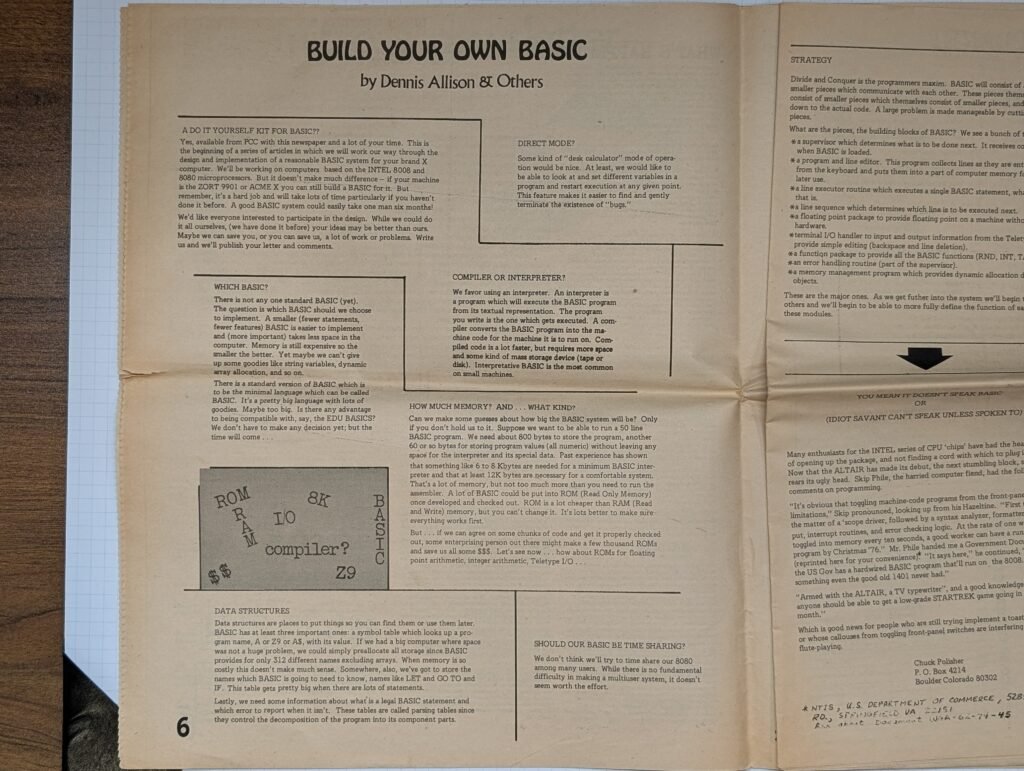
So in September 1975, PCC’s newsletter published Dennis Allison’s “Design Notes for Tiny BASIC.” The design notes were exactly what the name says: a design, not a program. Allison laid out a minimal, integer-only BASIC with a formal grammar, small enough to fit in two or three kilobytes of memory, and invited readers to implement it on their own machines and send the results back to PCC. He was modest about the whole thing, writing that “our goals are very limited — to provide a minimal BASIC-like language for writing simple programs.”
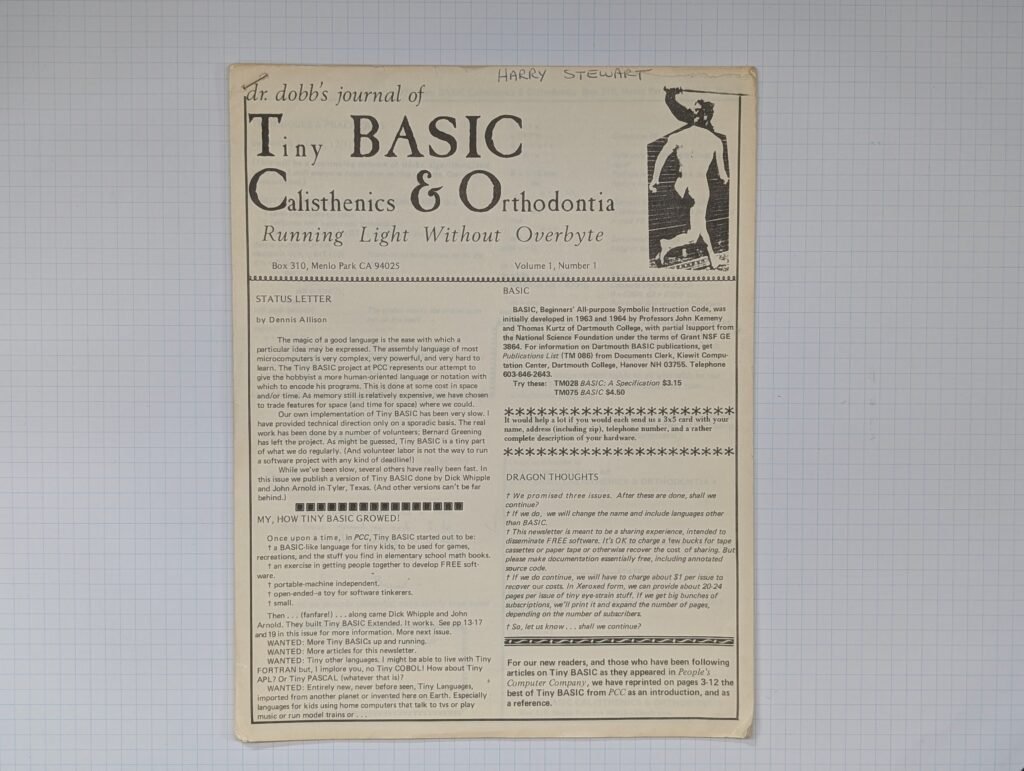
And readers did it. So many implementations and improvements came back that PCC started a whole new publication in January 1976 just to print them, with one of the great names in publishing history: Dr. Dobb’s Journal of Tiny BASIC Calisthenics & Orthodontia. I have a copy of that first issue on my shelf. It originally belonged to a programmer named Harry Stewart, but that’s a story for another post.
The front page of that first issue says why Tiny BASIC existed, in their own words. Under the heading “MY, HOW TINY BASIC GROWED!” it recaps: “Once upon a time, in PCC, Tiny BASIC started out to be: a BASIC-like language for tiny kids, to be used for games, recreations, and the stuff you find in elementary school math books… an exercise in getting people together to develop FREE software… portable-machine independent… open-ended–a toy for software tinkerers… small.” A language for kids, built together, given away. No mention of Bill Gates anywhere on the page.
Bill Gates’s open letter is dated February 3, 1976.
By the time the letter appeared, Allison’s design notes were five months old and Dr. Dobb’s already existed. Tiny BASIC wasn’t a response to Bill Gates. It was a response to the Altair, and to the thousands of people who suddenly had a computer with no accessible, affordable way to learn to program it.
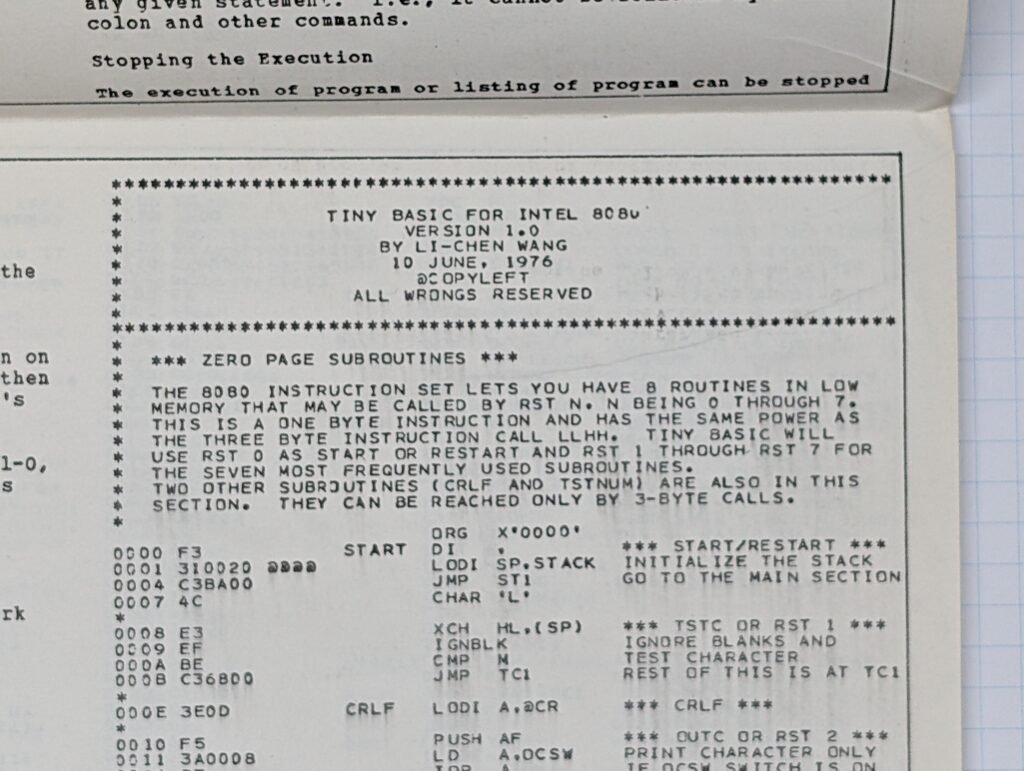
Now, the fight over paying for software was real, and it shaped what came next. Tom Pittman later wrote that he sold his Tiny BASIC for $5 because there was “a lot of whining about Bill Gates charging $150 for his Basic interpreter” at the Homebrew Computer Club, and he wanted to prove that people would happily pay a fair price. Li-Chen Wang put “@COPYLEFT: ALL WRONGS RESERVED” in the title of his Palo Alto Tiny BASIC, poking fun at the whole idea of restricting software, fifteen years before free software had a legal framework. But those came after the design notes, not before. The letter poured gasoline on a fire PCC had already lit.
I think I understand why the story gets told backwards. A community rising up against a villain makes a better story than a community carrying out a plan it already had. But the backwards version sells these people short. They weren’t reacting to Microsoft. They were answering the question PCC had been asking since 1972: how do you get computer power to the people? A free, understandable BASIC for these new machines was simply the next step.
So consider this a correction to my own video. The real history is better than the version I repeated, and I’d rather get it right.
There is a lot more to say about Tiny BASIC, especially about how it worked on the inside. Allison’s design included a tiny virtual machine that let one interpreter move between completely different processors, and digging into how it works has been one of my favorite parts of this research. More on that soon.
Leave a Reply